
Enantioselective Deaminative crosscoupling of amino acid derivatives and alkylzirconocenes
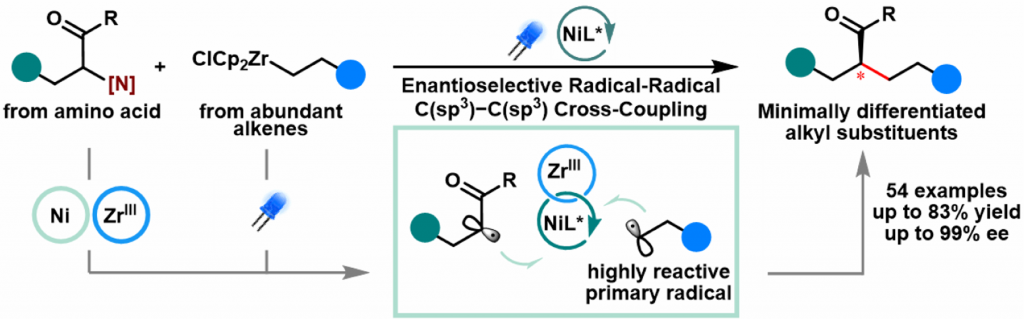
The enantioselective constructionof C(sp3)-rich architectures fromrenewable feedstocks remains a formidable challenge in synthetic chemistry, particularlywhen targeting stereocenters withminimal steric differentiation.While radical chemistry provides access to C(sp3)-rich motifs under mild conditions, catalyst-controlled enantioselective radical−radical coupling
for such subtly differentiated aliphatic stereocenters has remained elusive. Here,we disclose a visible-light-mediated, nickel-catalyzed enantioselective deaminative cross-coupling of naturally abundant amino acids with unactivated alkenes via in situ-generated alkylzirconocenes. This operationally simple protocol operates without external photocatalysts or stoichiometric reductants, leveraging the intrinsic photoreactivity of alkylzirconocenes to generate both alkyl radicals and the reducing Cp2Zr(III)Cl species.
The method exhibits broad functional group tolerance and delivers a wide array of chiral amides with high efficiency and excellent enantioselectivity (up to 83% yield and 99% ee). Notably, it enables the asymmetric construction of stereogenic centers bearing minimally differentiated alkyl substituents that differ by amethylene unit or heteroatom, directly addressing a long-standing challenge in asymmetric catalysis. Mechanistic investigations support a radical−radical cross-coupling pathway controlled by achiral nickel catalyst, with Cp2Zr(III)Cl serving as a key reductant to sustain the catalytic cycle. This work establishes alkyl zirconocenes as versatile platforms for enantioselective radical transformations and offers a sustainable route to value-added chiral carbonyl compounds fromaminoacids.
https://doi.org/10.1021/jacs.6c10406?urlappend=%3Fref%3DPDF&jav=VoR&rel=cite-as